
The right tool to cut circles in wood for different jobs
Quick answer by circle size and finish
For accurate general-purpose circle cutting in wood, a router with a circle-cutting jig is usually the strongest choice. It can produce clean discs, round openings, speaker holes, tabletops, and repeatable arcs when the pivot point is set correctly. For small holes, a hole saw or Forstner bit is faster. For rough circles that will be sanded later, a jigsaw is practical and affordable. For repeated outside curves in a shop, a band saw with a circle jig can be efficient. The right tool depends on four details: diameter, whether you are keeping the inside or outside piece, wood thickness, and how clean the finished edge must be.
A single cutter is rarely the best answer for every circular cut. A 2-inch cable pass-through, a 10-inch clock blank, a 24-inch tabletop, and a shallow round tray recess all suit different setups. Use the comparison below as a starting point before choosing the method. You can also explore more in Tool Categories.
| Job type | Good tool choice | Best use | Main limitation |
|---|---|---|---|
| Small through holes | Hole saw | Door hardware, pipe openings, wiring holes | Can leave tear-out and a plug inside the cup |
| Flat-bottom recesses | Forstner bit or router template | Hinge cups, trays, inlays, shallow pockets | Diameter range is limited by bit size |
| Accurate large circles | Router with circle jig | Tabletops, speaker cutouts, round panels | Needs a pivot hole or temporary center block |
| Rough or one-off curves | Jigsaw | DIY cutouts, oversized blanks, quick shaping | Edge often needs sanding or trimming |
| Repeated outside discs | Band saw with circle jig | Shop-made round blanks and craft production | Not suitable for closed interior holes without an entry cut |
Start with the circle you actually need
Before choosing a tool, define the finished part. Woodworkers often use the word “circle” for several different cuts. A circular hole removes the center and keeps the surrounding board. A disc keeps the center and removes the outside waste. A recess removes only part of the depth. A ring needs both an inside and an outside circle. Each version changes the safest and cleanest cutting strategy.
For a through hole, the tool must clear waste efficiently and keep the opening close to size. Hole saws, Forstner bits, routers, and jigsaws can all do the job, but the finish quality is not the same. For a round disc, the outside edge matters most, so a router jig, band saw jig, or rough-cut-and-trim workflow is usually better. For a recess, a router is often more controllable because it removes material in shallow passes instead of all at once.
Diameter is the next filter. Very small holes belong to drill bits. Medium holes can be made with hole saws or Forstner bits. Large circles are where jigs become important, because hand-guiding a saw around a pencil line is rarely as consistent as rotating a cutter around a fixed pivot.
Material affects the result as well. Plywood, MDF, hardwood, softwood, and laminated panels all behave differently at the edge. Plywood can splinter across the face veneer. MDF creates fine dust. Hardwood may burn if the cutter is dull or the feed speed is too slow. Laminated panels can chip on the top surface. The cleaner the surface needs to be, the more important it is to support the fibers, take lighter passes, and leave room for a final trimming cut.
Router and circle jig for clean, accurate circles
A router with a circle jig is the most versatile option when accuracy and edge quality matter. The jig works like a compass: one point pivots at the center of the circle while the router bit cuts at the chosen radius. Because the distance from pivot to bit controls the circle, the setup can be adjusted for many diameters without buying a different cutter for every size.
This method is useful for speaker cutouts, round tabletops, lazy Susan parts, stool seats, decorative panels, and circular templates. A plunge router makes the process easier because the bit can enter the work gradually. A fixed-base router can also work in some setups, but it requires more care when starting the cut.
The cleanest workflow is usually not one deep pass. Mark the center, secure the workpiece to a sacrificial board, set the radius, and cut in several shallow passes. Many manufacturer instructions for circle guides emphasize a center pilot point and multiple passes because heavy cuts can overload the tool, heat the bit, and make the edge harder to control. A straight bit can work. An up-cut spiral bit clears chips effectively but may increase top-edge fuzzing on some plywood. A down-cut spiral bit can leave a cleaner top surface, but it may pack chips in a deep cut, so pass depth and dust extraction become more important.
There are two common ways to avoid a visible center hole. First, attach a temporary scrap block at the center with strong double-sided tape and put the pivot hole in that block. Second, cut the circle slightly oversized, then use a template or bearing-guided bit for the final edge. Both methods take more setup time, but they are useful when the finished face cannot show a pivot mark.
A router also handles rings well if the cuts are sequenced correctly. In most cases, cut the inner circle first while the center area is still supported, then cut the outside circle. For a loose disc, leave small tabs or use a sacrificial board so the work does not shift as the final fibers are cut. If the part moves while the bit is spinning, the circle can be damaged in the last few inches.
Hole saws, Forstner bits, and adjustable cutters for smaller circles
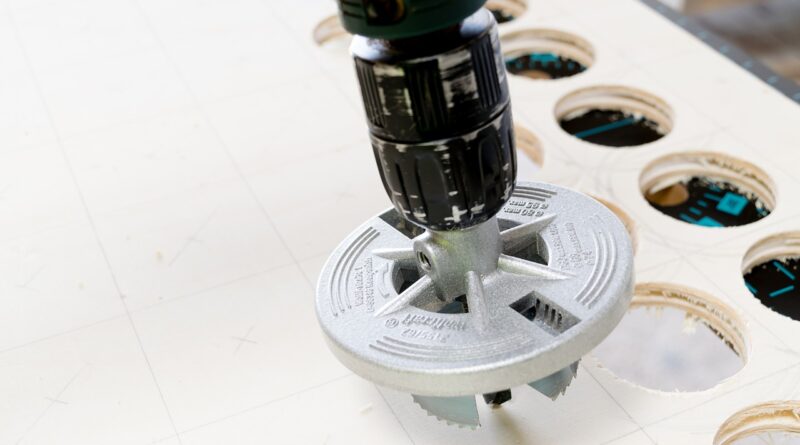
For smaller round openings, drilling is often faster than routing. A hole saw is a toothed cup that cuts a circular kerf and leaves a plug. It is a common choice for wiring, plumbing, locksets, desk grommets, and rough openings that will be covered by trim or hardware. It is not always the cleanest tool for furniture-grade edges, but it is convenient because it works with a drill and needs limited layout.
A Forstner bit is better when you need a cleaner hole, overlapping holes, or a flat-bottom recess. Cabinet hinge cups, counterbores, round pockets, and decorative recesses are common examples. Forstner bits perform best with steady alignment, so a drill press gives better control than a handheld drill. With a handheld drill, it is easy to tilt the bit and make the rim uneven.
Spade bits are another option for rough holes, although they are usually less refined. They are useful in construction work where speed matters more than a crisp edge. Auger bits are strong for deep boring but are not the usual choice for visible circles.
Adjustable circle cutters, sometimes called fly cutters, can cut larger diameters than many fixed bits, but they require caution. They are typically better suited to a drill press at controlled speed, with the work clamped firmly. Because the cutting arm rotates in a wide path, a loose workpiece or handheld setup can become hazardous. For many general DIY users, a router jig is a more controlled choice for larger visible circles.
When drilling through wood, tear-out on the exit side is a common problem. A sacrificial backer board reduces splintering. Another method is to drill only until the center pilot breaks through, flip the work, and complete the cut from the opposite face. This takes more time but often leaves a cleaner edge on both sides.
Jigsaw and band saw options for curves and blanks
A jigsaw is the accessible answer for many one-off circles. It can cut curves in sheet goods, countertops, plywood panels, and boards without a large stationary machine. With a narrow blade, patient feed rate, and a clear layout line, a jigsaw can produce a usable circle for many DIY projects. It is also useful for removing most of the waste before a router makes the final clean pass.
The main limitation is edge quality. Jigsaw blades can deflect, especially in thick stock. The top line may look acceptable while the bottom edge wanders. The smaller the radius and the thicker the material, the more visible this problem can become. A sharp blade designed for clean wood cuts helps, but a jigsaw-cut circle usually needs sanding, filing, or router trimming if the final edge will be seen.
A simple jigsaw circle jig can improve consistency. The idea is similar to a router trammel: the saw is attached to an arm that pivots around the center. This reduces layout error, although it does not eliminate blade deflection. For rough cutting, it is often enough. See also: Brands.
A band saw is efficient for outside circles and repeated round blanks. With a circle-cutting jig, the blank rotates around a pivot while the blade cuts the perimeter. Because the machine is stationary and the work is supported by the table, the process can feel controlled once the jig is tuned. It is commonly used for turning blanks, craft discs, and parts that will later be sanded or routed.
However, a band saw blade is a continuous loop, so it cannot simply appear inside a closed panel to cut an interior hole. For a closed inside cut, you need an entry path, a different tool, or a design that allows the cut to be hidden or repaired. That is why routers and jigsaws are often more practical for sink openings, speaker holes, and other interior circles.
A practical workflow for cleaner results
The best results often come from combining tools rather than forcing one tool to do everything. When making a large circular tabletop, for example, you can rough-cut outside the line with a jigsaw, then use a router and circle jig for the final edge. This reduces the amount of material the router bit must remove and can produce a cleaner surface with less strain on the tool.
For a circular hole in plywood, you might score the face veneer, drill a starter hole, cut close to the line with a jigsaw, and finish with a router template. For a small hardware opening, a hole saw with a backer board may be enough. For a shallow decorative recess, a router template may give more control than trying to find a single oversized drill bit.
Use this decision path:
- If the diameter is fixed and small: choose a drill bit, hole saw, or Forstner bit.
- If the circle must be large and accurate: choose a router with a circle jig.
- If the cut is rough and speed matters: choose a jigsaw and plan to sand.
- If you are making many outside blanks: consider a band saw jig.
- If you need a flawless visible edge: rough-cut first, then trim with a router.
Measurement deserves as much attention as the cutter. The radius is half the diameter, but the cutting edge has thickness. When using a router jig, set the distance from the pivot point to the cutting edge that defines the finished circle, not merely to the center of the bit. If you are keeping the inside disc, the outside edge of the bit matters. If you are keeping the surrounding panel and removing the hole, the inside edge of the bit matters. A test cut in scrap is the simplest way to confirm the setup before cutting the final workpiece.
You can find more tool-category guides and comparisons in the Tool Categories section.
Safety and setup checks before cutting
Circle cutting creates several risks that are easy to underestimate. The workpiece may rotate, the offcut may break free, the center pivot may loosen, or the blade may bind as the circle closes. Secure the stock to a stable surface, support both the keeper piece and the waste, and keep hands away from the cutting path.
For routers, take shallow passes and let the bit reach full speed before entering the wood. Do not trap the cord around the pivot path. If the jig requires a center pin, make sure it stays seated throughout the cut. If the final disc will come loose, leave tabs, use a backer board, or stop before the last pass and secure the part again.
For saws, choose the blade for the material and radius. A blade that is too wide for a tight curve will resist turning and can burn or wander. A dull blade encourages pushing harder, which usually makes the cut worse. For drill-based cutters, clamp the work and use a backer board when possible. Large-diameter cutters should not be treated like ordinary twist drills.
In workplace settings, OSHA’s portable powered tool rules include guarding requirements for portable circular saws with blades greater than 2 inches. For home and shop use, the practical lesson is similar: keep guards in place, use eye and hearing protection, manage dust, and follow the tool manufacturer’s manual for the specific cutter, speed, and setup.
Frequently asked questions
What is the easiest tool to cut circles in wood?
For a quick rough circle, a jigsaw is usually the easiest because it is portable and needs little setup. For an accurate circle with a clean edge, a router with a circle jig is usually the better choice, even though it takes longer to prepare.
Can I cut a perfect circle in wood without a router?
Yes, but “perfect” depends on the tolerance you need. A hole saw or Forstner bit can make clean small circles. A band saw with a circle jig can make accurate outside discs. A jigsaw can follow a circle, but the edge usually needs sanding or trimming.
What tool should I use for a large wooden circle?
For a large visible circle, use a router with a circle-cutting jig. If the material is thick or the circle is very large, rough-cut near the line with a jigsaw first, then make the final pass with the router. This reduces load and improves the edge.
How do I cut a circle in wood without leaving a center hole?
Attach a temporary block at the center and place the pivot in that block, or use a template-based routing method instead of a direct pivot. The temporary block method is often simpler, but it requires reliable tape or clamping so the pivot does not shift.
Is a hole saw better than a Forstner bit?
A hole saw is better for many through holes, especially when the opening will be covered by hardware or trim. A Forstner bit is better for cleaner rims and flat-bottom recesses. For larger custom diameters, a router jig becomes more flexible than either one.